An interview with Amy Goldberg, editor-in-chief
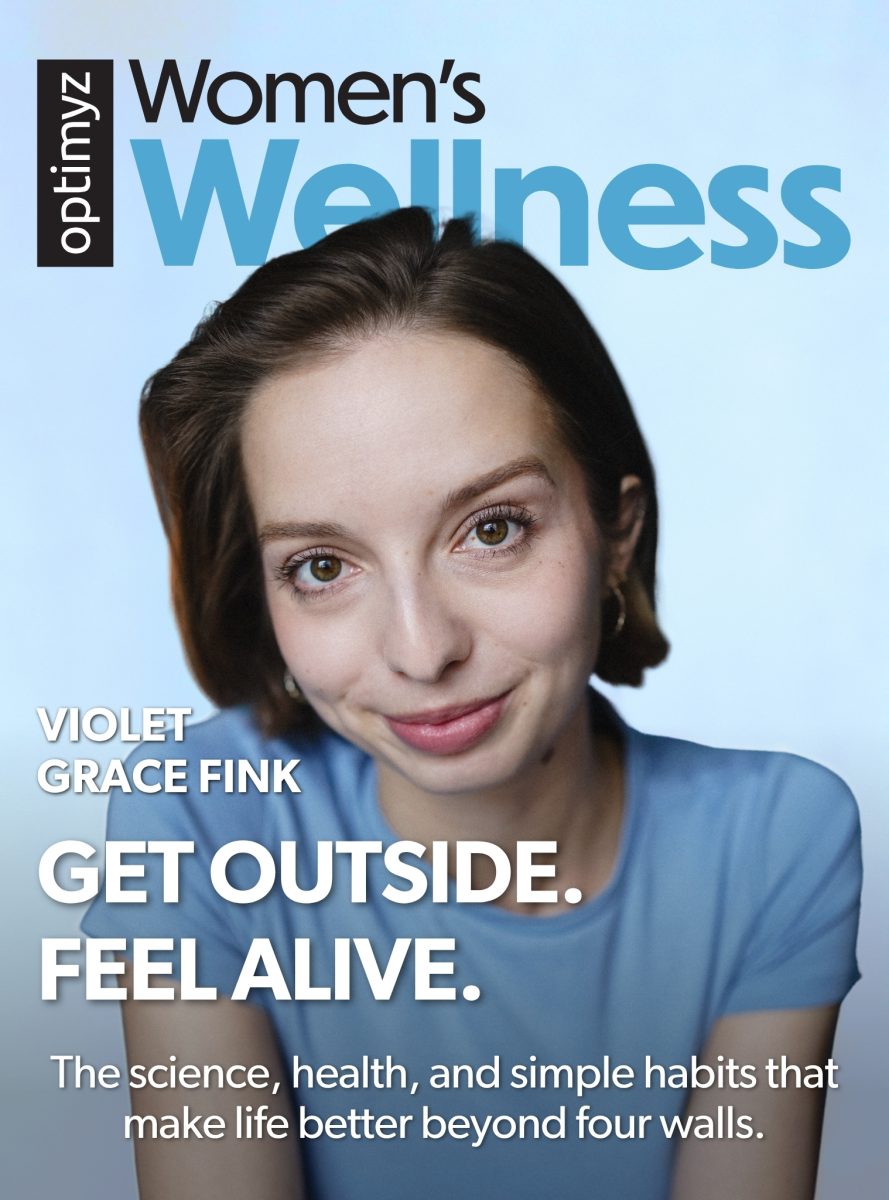
For actor, writer, model, and creative entrepreneur Violet Grace Fink, life has always been about exploring beyond the obvious. Raised between the creative pulse of Los Angeles and the expansive natural beauty of Waimea, Violet grew up moving between two landscapes that shaped her understanding of both creativity and connection to the natural world.
Her journey later brought her to London, where she trained for both stage and screen and completed a BSc in psychology before returning to her first love; performance. But Violet’s work extends beyond acting. She collaborates with her mother, actress and filmmaker Jane Sibbett, on the uplifting platform Noon Miracle, a community centered around presence, intention, and daily moments of reflection. She has also co-founded fINK PRESS with her sister, a publishing company focused on sharing meaningful stories and creative voices.
At the heart of everything Violet does is storytelling. Her goal is simple but powerful: to create moments where people feel seen, heard, and understood in the wonderfully strange experience of being human.
In our July issue, themed Get Outside, Violet reflects on the many ways stepping outside—physically, creatively, and emotionally, opens us to new perspectives. From nature and travel to creative risk-taking and collaboration, getting outside the familiar often reveals who we really are.
This conversation explores creativity, nature, psychology, and the courage it takes to step into the unknown.
You grew up between Los Angeles and Waimea, two places with very different landscapes and rhythms. How did those environments shape your sense of curiosity and connection to nature?
I feel very lucky that my whole family are great lovers of the outdoors. As kids, in both Topanga and Waimea, we were encouraged to go outside and explore for as many hours as we wished, as long as we were home by dinner. (This encouragement was helped by the fact that we didn’t have access to any form of television, so the alternative was staying inside and reading, which we also did often.)
In California, this typically meant that I hurried to keep up with my older siblings, scrabbling up sandy rock faces and keeping an eye out for rattlesnakes. I was endlessly curious about the world that my siblings seemed to know so well and would pester them with questions about different rock, shrub, and animal types for the duration of our hikes. I feel that the landscape in Topanga, with its sprawling dusty trails winding through the manzanita bushes and lizards darting underfoot, was the one that characterized my curiosity. Hawaiʻi, with its lush greens and cascading waterfalls and vibrant, many-layered rainbows, solidified and deepened my connection with nature.
I spent more time alone, no longer rushing for fear of being left behind. I spent my days wandering through fields where the grass sometimes stretched taller than my head, discovering ponds where lotus flowers bloomed steadily from the centre and dragonflies darted about, sleeping on the moss beneath the ʻohiʻa trees whilst fluffy clouds towered in the blue skies, and staying up far too late to watch the glimmer of the Milky Way light the night sky. The slower pace of Hawaiʻi living allowed me to be more present and aware of the natural world. I no longer questioned everything, I simply learned to enjoy every bit of it.
Our July theme is “Get Outside.” What does ‘getting outside’ mean to you beyond simply spending time outdoors?
‘Getting outside’ means many things to me, beyond the obvious. Getting outside your own head and allowing yourself to engage, connect, and act without analyzing each detail of what you’re doing is a key one. Pushing the boundaries of the norm, getting creative and exploring a new space where there is no right or wrong, there is simply existence is another. Releasing the self-imposed rules formed by yourself or by society to return to simple silliness and the joy of being alive, this is possibly my favorite form of ‘getting outside’.
Ultimately, I think these and many other interpretations are, at their purest form, about release and freedom. When we are locked into predictable schedules, commitments, and responsibilities, it can feel as though nothing will ever change. It is only when we step outside of that mindset that we discover how boundless the possibilities truly are.
Nature often has a way of resetting our perspective. Are there places or environments that help you reconnect with yourself when life gets busy?
Yes! Swimming in virtually any body of water, but particularly in the ocean always serves as a full factory reset for me. Anything that’s been plaguing my mind or my body finds instant release in the saltwater. Unfortunately, I no longer live as close to the ocean as I used to, so I’ve had to seek alternatives. Now, whenever I’m feeling stressed or down or anxious about anything in the big, wide world, I go to one of the green spaces near me and take a long walk through the trees. Movement helps me reconnect with myself, too. Regular Pilates and yoga classes help me stay centered in my body and mindful in my life. But when I feel a little extra out of touch, there’s no cure like getting out into the fresh air and feeling the sun on your face.
You took time away from acting to pursue a psychology degree. What insights about human behaviour did that experience give you that now influence how you approach your roles?
Studying psychology has absolutely given me a wholly different perspective when it comes to getting inside the head of my characters. Though what I learned in the degree itself is most useful when it comes to characters with mental illnesses, a key part of our education was also listening for what people aren’t saying. Paying attention to the physical and verbal cues of withholding, noticing the coping mechanisms and behavioural patterns, these are essential skills for people working in the field of psychology, and layering them into my character’s actions gives the role a nuance and depth that’s grounded in reality.
This also means that when I’m acting, I’m still trying to read between the lines of what the person I’m playing opposite is saying. Even though I know the story and everything that’s supposed to happen, the more I focus on actually listening to their words and their intent, the more present I am in my performance and in my role.
You collaborate with your mother, Jane Sibbett, on Noon Miracle. What has that experience of creating something meaningful together taught you about connection and purpose?
The work that we’ve been doing for our shared vision of Noon Miracle has taught me so much. For those who aren’t familiar, Noon Miracle is a platform that hosts online courses, table reads of all kinds of scripts, writing salons, a video library of projects from artists around the world. The purpose, at its core, is to have a multidisciplinary space that inspires people. Working daily towards that goal has been incredibly fulfilling in so many ways.
We developed Noon Miracle just over a year ago (based on the original idea from the 80s) and honestly, it’s been kind of a “pinch me” moment. We’ve had names like Lisa Kudrow, Maggie Wheeler, Richard Kind, Dan Butler, and Mark Moses around our virtual table to read, we’ve published three anthologies from the work created in the workshops led by Amy Ferris, and we’ve been able to offer significant scholarships, helping to remove barriers for women who want to hone their craft in our online courses.
It’s taught me how essential it is to have people close to you who support and encourage you chasing your wildest creative dreams.
You also co-founded fINK PRESS with your sister. What inspired you to create a publishing platform, and what kinds of stories are you passionate about bringing into the world?
The creation of fINK PRESS was such a natural extension of what Ruby, and I had independently been doing (and had always dreamed of doing) a few years ago that it felt a little silly that we hadn’t come together to collaborate sooner. She has a brilliant mind for story, structure, and development, and I love the rhythm of formatting and the artistry of designing the covers. We had both been helping people to get their manuscripts in order for self-publishing to different degrees. So, I called her one day and said, “This might be crazy, but…”
We’ve been working together happily for nearly two years, and we’ve had so many lovely projects cross our desk! Tales of horses and wildfires, unicorns and narwhals, and even one that I illustrated about a little girl and her magical blanket. We love all sorts of stories, from memoirs to children’s books, but I think the ones that I’m most passionate about are the ones that people have had sitting on their shelf for a long, long time. There’s something so rewarding about helping someone publish a story they had nearly given up on. It breathes life back into a dream they had once, and you can see them light up as it begins to take shape and become a real paper-and-board book.
Living in London after growing up in the United States must have been a shift. How has that move influenced your creativity and personal growth?
Moving to London for university was certainly a shift! Though I was already fairly independent when I moved, I think living in an entirely new country taught me to be self-sufficient in a very different way. I had to start practically from scratch, which was a prospect that was both exciting and a little daunting to me. The friends I made, the work I found, the mistakes and the slip-ups and the inevitable consequences would all be my responsibility.
Fortunately, London is a very cosmopolitan city; I was not so much an outsider (as I feared I might be) as one piece in the ever-growing patchwork of people that made up the city. With such a wide variety of cultures, histories, religions, political beliefs, sexualities, artistic inclinations, backgrounds, identities, it didn’t feel difficult to assimilate. I found friends, a job, and fell in love. I stayed here through the pandemic, moved house, broke up, and fell in love again.
The city grows like the rings of a tree. It contains every age it has ever been within it, expanding slowly, covering and recovering parts of itself as time wears on. But it doesn’t merely cling to its history, it reinvents it. It celebrates it. It tells old stories with a new spin, performed on the spotlit stages of the West End and in the shadowy crypts of crumbling churches. It’s difficult not to feel inspired by it all. Creation begets more creation, and the work that I’ve produced since moving here has certainly been heavily influenced by the richness of the history, culture, and people of the UK.
When you feel creatively stuck or overwhelmed, what helps you step outside the noise and reconnect with inspiration?
Any time I feel a bit stuck, whether it’s on a plot point that’s not developing how I want it to or an idea that I haven’t really been able to flesh out yet, I immediately call someone to talk about it. I am incredibly blessed to be surrounded by so many brilliant, sharp, creative minds that all have a willingness to get stuck in the weeds with me, no matter what the project is. We’ll chat over a coffee or just over the phone, and by the time the conversation is over, I’ll be spilling over with inspiration, desperate to get back to my laptop or my notebook to start scribbling down every new idea we’ve come up with.
It happens even when I’m not seeking new inspiration! Back in mid-March, I was getting lunch with a friend, and I mentioned a theatre festival that was seeking new pieces of writing. The deadline for submissions was a little less than two weeks away and we joked about scrambling to pull a completely new play together before the application window closed. Two hours later, it was no longer a joke. And nine days later, we had a rough draft that we could shape enough to submit. Inspiration strikes like lightning when you’re with people who make you more receptive to it.
Getting outside can also mean stepping outside our comfort zones. Has there been a moment in your life or career where taking that leap changed your direction?
I’ve made a few life-changing leaps that all required me to exist outside of my comfort zone for a while.
Moving to a new country where I knew a grand total of one person when I was 18 was probably the first of those big leaps, though it also seemed like the perfect time to do it. The pre-established community of a university was key to my feeling immediately connected to the new environment and helped keep the homesickness and loneliness at bay.
Deciding to forego a (relatively) stable career in psychology in favour of pursuing my creative dreams was also a bit of a leap. I had to admit to myself that, for all my love of the subject, I couldn’t commit to that path without feeling like I’d left a part of myself behind.
And, more recently, I’ve taken another leap in starting to write my own material. For the past few years, particularly in theatre, I’ve felt a certain security in knowing that my performance can be separated from the script and the story. I’ve been very lucky to be involved in shows that have dealt with a wide variety of difficult topics in an honest, unflinching way. But the longer I stay in this space, the more I realize how much I want to tell my own stories, too. And it’s terrifying! It’s exposing! But despite it being firmly planted outside of my comfort zone, I still want to share work that I’ve written with the world.
In a world where so many of us are glued to screens, why do you think reconnecting with the outdoors, and with each other, matters more than ever?
Our modern world is filled with more opportunities for isolation than ever. We’ve been sold a dream of convenience: groceries delivered directly to your door, apps that allow you to check in with your friends without ever having to leave the house, livestreams of concerts and events that save you from the crowd. Technological advances often, by degrees, shift us further and further away from the experiences that used to connect us.
Fortunately, this world is also filled with more opportunities for real connection than ever before. Or, rather, all the same opportunities to connect exist, but the desire to engage in them has been reignited. Just last week, I met a group of people who had scaled a cliff together and were learning how to abseil (or rappel) from one of their friends training to be an instructor simply because he had called them that morning to see if they were free. He let us try, too.
There’s a growing movement to drop off the grid for a mental health break, to go out dancing with friends, to meet people organically, to lose yourself (safely) in the wilderness and only return when you’re feeling more regulated. I think all of these things are utterly essential to being a happy and healthy human being. We’re not designed to be apart. We are more ourselves when we are physically present in our community and in the natural world, and I celebrate every effort to return to this.
Looking ahead, what kinds of stories or creative collaborations are you most excited to explore next?
If I had to choose the project that I’m most excited to bring to life over the next few months would be a creative collaboration with my insanely talented group of friends. It’s a 60-minute play exploring toxic power dynamics, female rage, and the things people are willing to sacrifice to get what they want. If all goes well, it will be the first piece I’ve ever performed on stage that I’ve been partly responsible for writing, which, truth be told, is a little frightening. But mostly, I’m delighted to have the chance to learn, grow, and play in this space with people I trust and admire. It’s the greatest gift.
Thank you, Violet.
I’m inspired by how Violet approaches life and storytelling with curiosity, empathy, and a deep respect for the shared human experience. Whether she’s performing, writing, publishing, or creating community through Noon Miracle, her work is rooted in connection.
As summer invites us to open the door and step outside, Violet reminds us that discovery often begins with a simple act: leaving the familiar behind and stepping into the wider world, where creativity, nature, and meaningful connection are waiting.